
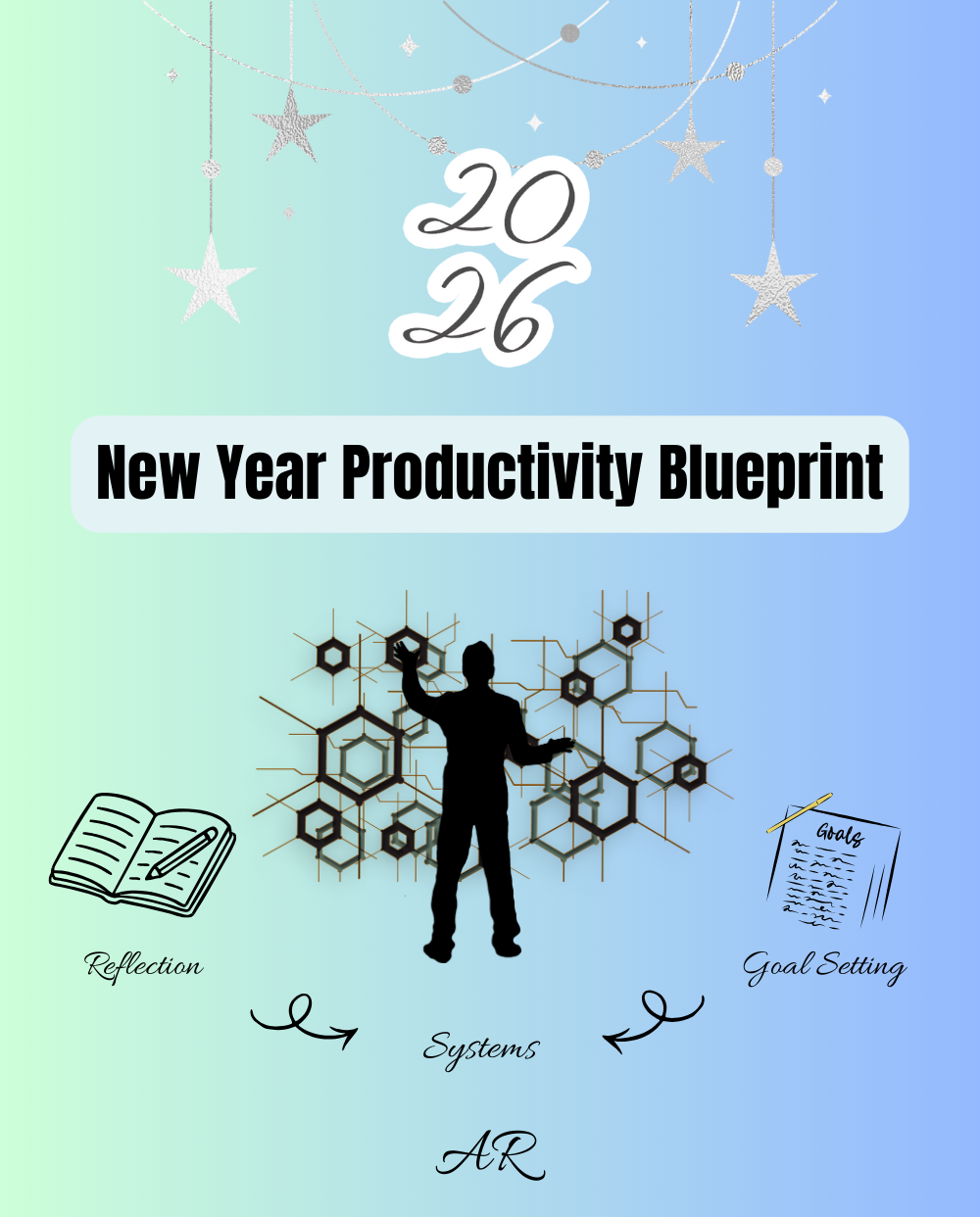
Your New Year Productivity Blueprint: From Goals to Systems That Work
Start your year the right way!
For most people, every year begins the same way: New goals, high motivation, and the hope that this will finally be the year everything changes. However, by February or March, most of that momentum usually fades.
This pattern isn’t a failure of discipline alone. It’s not even a failure of motivation. The real issue is that most people try to improve their productivity by relying on motivation and pushing harder, instead of building better systems that will make discipline easier.
Most people assume that successful and productive people are simply more disciplined. While it is partly true, if you look closer, you’ll find that they have built better systems that make success a matter of time.
Productivity isn’t about doing more. It’s about consistently doing what truly matters with clarity and intention. Based on the latest productivity workshop I designed and taught, this article will walk you through three essential steps to becoming the most productive version of yourself: closing the year properly through reflection and review, setting goals the right way, and building systems that make progress inevitable.
The importance of design: Systems > Motivation
One of the most common misconceptions about productivity is the belief that progress depends on staying motivated. Relying on motivation is the first step to failure.
Research studies have shown that habits and systems can trigger consistent action even when motivation fluctuates. Everyone knows that motivation depends on many things, including energy, mood, stress, and life circumstances. Even when we are passionate about something, there will be days when motivation is simply not there. So, why rely on it and give it so much power over yourself?
Your productivity will significantly improve when you stop asking yourself “How can I stay motivated?” and instead ask, “How can I make progress even when motivation is low?” The answer lies in systems.
A system is a repeatable structure that supports action regardless of how you feel. When designed well, systems reduce friction, make discipline easier, and turn intention into execution. They allow you to show up consistently without needing constant willpower. In other words, systems do the heavy lifting when motivation fails.
Your goal is not to feel inspired every day. Your goal is to design your life in a way that makes progress the default.
Step one: Close the year properly through reflection
Before thinking about new goals or better systems, it is essential to look back. Setting goals and building systems without reflecting on the previous year is like planning a journey without checking where you currently stand.
Reflection is not about judging yourself or dwelling on mistakes. It is a deliberate process of reviewing experiences to extract lessons, increase self-awareness, and make better decisions going forward. Research consistently shows that structured reflection improves learning, planning, and future performance.
A useful way to begin is to assess key areas of your life — work, health, relationships, personal growth, and overall energy — and honestly evaluate how each area felt over the past year. From there, deeper questions matter far more than surface-level outcomes. What activities energized you? What consistently drained you? Where did you procrastinate, and why? What are you genuinely proud of?
The goal is not to tell stories, but to identify patterns. Patterns reveal what is sustainable for you and what is not. They show where your systems worked and where they quietly failed.
One powerful exercise I often recommend is imagining the past year as a research project. If your year had a thesis title, what would it be? This forces clarity and synthesis. It transforms a collection of experiences into insight — and insight is what guides meaningful change.
Step two: Set goals as directions not wishes
Once you finish your yearly review, goal setting becomes much more grounded and intentional. It is worth noting that knowing your direction through goals is very important, but it is not the work itself. Goals are just directions that guide your systems and daily actions.
Poorly designed goals create pressure, vagueness, and procrastination. Well-designed goals create clarity and momentum. The difference lies in how they are structured.
A strong goal defines not only what you want, but why it matters, what actions move it forward, and how those actions will be supported. Without these elements, goals remain hopeful ideas rather than executable plans. You should keep in mind that clarity reduces procrastination. Our brain resists vague goals.
Another common mistake is setting too many goals. Attention is finite, and overloaded systems collapse quickly. Fewer goals, chosen deliberately, lead to higher completion and deeper progress. When everything is a priority, nothing truly is.
A helpful framing is to imagine yourself at the end of the year and ask: If I were celebrating one meaningful achievement, what would it be? This question cuts through noise and helps you focus on what actually matters rather than what simply sounds impressive.
Goals should feel clear and directional, not overwhelming. Their job is to reduce uncertainty, not increase pressure.
So, which one do you think is a better goal? “Be healthier” or “Train 3x/week and sleep 7-8 hours/night”.
Step three: Build systems that make progress inevitable
Building a system to support your goals is the key to achieving them and making progress. A system can include your environment, habits, rules, and feedback loops. Just as in scientific research, outcomes depend far more on experimental design than on effort alone. Productivity works the same way.
One foundational system is deep focus. High-value work requires protected time and reduced fragmentation. When your schedule constantly shifts or your attention is repeatedly interrupted, progress slows dramatically, regardless of how many hours you work. Designing fixed periods for focused work allows depth, quality, and meaningful output to emerge.
Another essential system is energy management. Productivity follows biology. Without sufficient sleep, movement, and recovery, focus and consistency degrade quickly. Energy is not a bonus; it is the foundation upon which all productive work rests. Ignoring it makes every other system fragile. Work with your biology not against it.
Equally important is regular review and feedback. Without proper review, systems can fail quietly. A simple weekly review allows you to notice what is working, what is not, and what needs adjustment before small issues become major setbacks. This turns experience into learning and keeps your systems aligned with reality.
When goals and systems come together, they meet in your calendar. A well-designed week reflects your priorities, protects deep work, anchors energy, leaves space for life, and includes time for reflection. This is where intention becomes execution.
Conclusion: The most important principle of all
If you want to become the most productive version of yourself, start calmly, deliberately, and thoughtfully. Close the year properly. Set goals with clarity. Build systems that support you when motivation fades. Your responsibility is not to try harder this year. It is to design better.
Reflection gives you insight.
Goals give you direction.
Systems give you consistency.
The principles I share in this article comes from more than six years of research and experience on myself.
What is the one system that changed your productivity significantly?
Author

Ayman Reffai
Dr. Ayman Reffai is a dedicated PhD, Fulbright alumnus, and ReachSci committee member. He got his PhD with the highest honor in Molecular Biology, Medical Biology, Bioinformatics, and Biotechnology with affiliations at the School of Medicine, Stanford University (US), and FSTT, Abdelmalek Essaadi University (Morocco) as part of the Fulbright program. Dr. Ayman Reffai is driven by a passion for scientific research and its potential to improve lives. With a strong commitment to making a positive impact on both the scientific community and society at large and a desire to inspire and guide others, Ayman actively engages in research, teaching, mentoring, and fitness endeavors.

Leave a Reply