
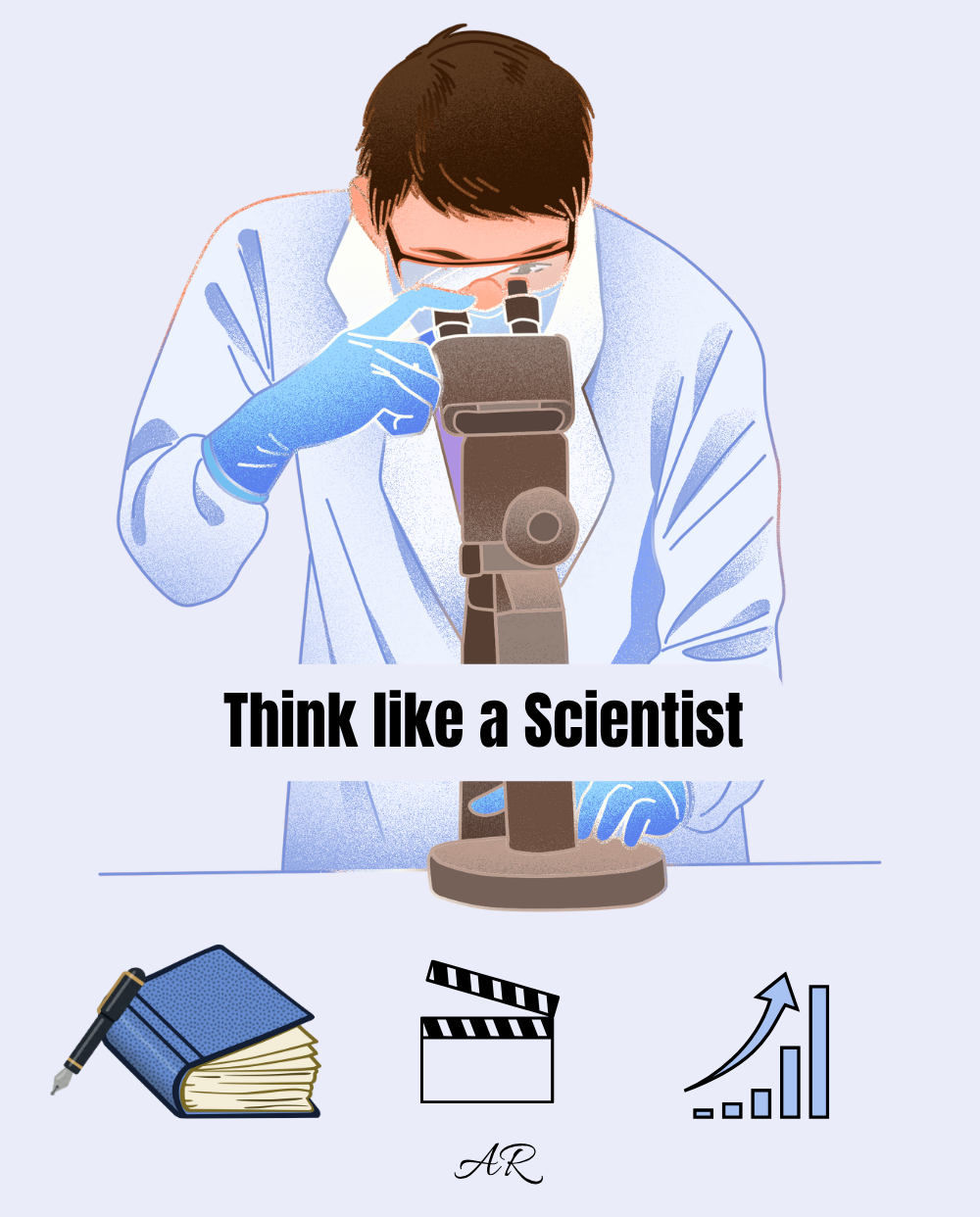
Think Like a Scientist: How Lab Habits Can Transform Your Productivity and Everyday Life
In the lab, ideas may emerge by chance — but their execution never does. Every pipette movement, sample label, and experiment follows a system: deliberate, documented, and designed for precision. Over time, I realized that this structure isn’t just what makes good science possible; it’s what makes life work better, too.
Science teaches us to think in systems, to plan before we act, to stay consistent even when results don’t show immediately, and to document every step so we can learn from it later. These same principles — systems, consistency, iteration, and patience — are the hidden foundation of personal productivity.
Outside the lab, our days often feel more like uncontrolled experiments: random inputs, rushed execution, and little reflection. But what if we brought the same mindset we use in research into our everyday lives? What if we treated our goals, habits, and routines with the same curiosity, structure, and discipline that we apply to experiments?
In this article, I’ll share lessons from the lab as a scientist that can help you design better systems, think more clearly, and stay consistent — whether you’re running a complex project, building new habits, or simply trying to make your days more intentional.
1. System Before Action: Design is key
Before a scientist runs any lab experiment, they design it. They outline the hypothesis and goal, select reagents, prepare controls, and set up the workflow to minimize error and maximize clarity and results. In other words, they make the system work before the experiment begins. The same principle applies to productivity and life: design precedes performance.
Workflows are at the heart of this system. Labs rely on repeatable procedures, or standard operating protocols, to ensure precision, efficiency, and reliability. In everyday terms, this means setting up conditions that make success easier and mistakes less likely. You can’t expect consistent results from a disorganized system — whether you’re managing lab samples or managing your time. Design and pre-execution are where productivity is truly built.
In the lab, we prepare everything before the actual work begins so that once the experiment starts, execution becomes effortless. Outside the lab, this could mean planning your next day the night before, batching similar tasks together, blocking deep work sessions on your calendar, or creating templates and checklists that reduce friction. Systems remove the guesswork; they make consistency automatic.
When your environment and workflows are designed to support your goals, you don’t need to rely on bursts of motivation. Just like a well-designed protocol guides each experiment, a well-designed system guides your behavior. The goal isn’t to work harder, but to make doing the right thing easier.
Key takeaway: Productivity starts in design, not in action. Build the system, and the outcome will follow.
2. Action: Execution Is Just as Important as Design
A well-designed system is powerful, but it’s nothing without action. In science, even the most meticulously planned experiment is useless until you actually run it. Similarly, in life and work, planning without execution is worse than imperfect action. You can spend days perfecting a workflow or writing the “perfect plan,” but without doing, nothing changes. This is called planning paralysis.
Action is where theory meets reality. It’s where learning happens, and where data emerges. Just like in the lab, you won’t know what works until you test it. And, importantly, imperfect action is still progress: it generates insights, highlights gaps, and informs better planning next time. You don’t want to be stuck in the loop of planning paralysis.
Key takeaway: Planning matters, but action transforms it into results. Don’t let perfect planning become procrastination
3. The Lab Notebook Mindset: Document Everything
In the lab, nothing exists unless it’s written down. From sample IDs and reagent batches to unexpected results, every detail goes into the lab notebook. This isn’t just bureaucracy; it’s the backbone of reproducibility. Without documentation, there’s no way to trace what worked, what failed, or why a result turned out the way it did. The lab notebook transforms random activity into structured knowledge.
When I was conducting my PhD experiments, my notebook became my second brain. It captured everything, including protocols, errors, and even hypotheses for next time. Looking back at old pages often revealed insights I would have otherwise forgotten. In many ways, it was less about recording science and more about recording learning. This was key in optimizing a proteomic protocol at Stanford for my tissue samples, which later produced impactful scientific results on cancer biomarker discovery.
Outside the lab, the same principle applies. Documentation is how we learn from experience instead of reliving the same mistakes. Keeping track of what you’re working on, what went well, and what didn’t is the foundation of growth. It can be as formal as a daily journal or as simple as jotting quick reflections at the end of the day. If it’s not tracked, it won’t be improved.
Documenting your progress, your habits, goals, or even thought patterns, builds awareness and accountability. Over time, you begin to see patterns: what boosts your focus, what drains it, what routines actually move you forward. This documentation wouldn’t work if you don’t have reflection sessions to go through it.
Key takeaway: What gets written gets remembered. What gets tracked gets improved. Documentation isn’t just about memory — it’s about mastery.
4. Problem Solving Like a Scientist: Test, Don’t Guess
In scientific research, problems are inevitable. Experiments fail, and unexpected variables appear out of nowhere. Scientists don’t panic when an experiment fails; they refine it and try again. We use it as data that needs to be improved. Every error points to something new to learn, something to adjust, something to test differently next time.
That mindset — of testing instead of guessing — is one of the most powerful productivity habits you can apply in everyday life. When something isn’t working, most people assume they’re bad at it or give up too soon. Scientists, on the other hand, ask questions:
- What variable changed?
- What if I adjust this condition?
- What result am I actually measuring?
You can treat your habits, systems, and routines the same way. If your morning routine isn’t working, try a new sequence. If your focus drops every afternoon, experiment with your schedule and habits. If a project feels stuck, identify the bottleneck and isolate it like a variable in an experiment. By approaching challenges as hypotheses to test rather than problems to solve perfectly, you turn frustration into curiosity.
When I was troubleshooting an experiment or coding script, days of errors taught me the importance of patience and precision. Each repetition brought me closer to the answer — not through luck, but through small, intentional changes. Eventually, what once looked like “failure” revealed the insight I needed. Life works the same way: progress is often hidden behind a long sequence of controlled trials.
Key takeaway: Treat life like a living experiment. When something doesn’t work, don’t quit — iterate. Replace frustration with curiosity, and you’ll keep improving, one hypothesis at a time.
5. The Power of Consistency and Small Wins
In science, breakthroughs rarely happen overnight. Behind every published paper are hundreds of repetitive experiments, small adjustments, and quiet days of patient work. Each tiny step — preparing samples, running controls, refining parameters — contributes to a larger discovery. The same law of accumulation applies outside the lab: progress is simply the compound effect of showing up consistently.
Consistency works because it builds momentum. In behavioral science, every small win activates a reward signal in the brain — a brief dopamine release that reinforces the behavior and motivates us to repeat it. This mechanism explains why tracking progress, even in small increments, helps us sustain effort over time. The brain learns that action equals reward.
In the lab, we don’t expect success after one trial. We run dozens of iterations, knowing that every result — even a failed one — moves us closer to understanding. But in everyday life, we often expect instant transformation: a single workout to change our bodies, or one week of focus to change our productivity. Real growth, like good science, comes from patient repetition.
When I look back at my research journey, the biggest breakthroughs weren’t defined by dramatic discoveries. They were the product of showing up daily — documenting, refining, and trusting the process. The same principle applies to building habits, writing, or managing your goals: small, consistent wins compound into results that once seemed impossible.
Key takeaway: Don’t chase intensity — chase consistency. The small actions you repeat every day become the foundation of your biggest achievements.
6. Long-Term Gratification: Thinking in Timelines, Not Timetables
Every scientist learns patience early on. Experiments take time — sometimes days, sometimes months — and results rarely appear when you expect them. You learn to trust the process even when progress feels invisible. In science, rushing rarely leads to breakthroughs; it usually leads to mistakes. Over time, this rhythm teaches one of the most valuable life lessons: lasting success requires long-term thinking.
Our world, however, celebrates immediacy — quick results, fast responses, instant feedback. But the lab teaches a different kind of rhythm: long-term gratification. You learn to delay the dopamine hit of quick wins in exchange for the deeper satisfaction of meaningful progress. This mindset shift transforms not only how you work, but how you think.
In neuroscience, delayed gratification strengthens the prefrontal cortex — the part of the brain responsible for planning and decision-making. Every time you choose process over impulse, you train your brain for patience, focus, and resilience. In other words, waiting isn’t passive — it’s an active discipline.
During my PhD, there were months when nothing seemed to move forward — just repetition, calibration, and data cleaning. But looking back, those slow months were where growth happened. They taught me that progress isn’t always visible; it’s often accumulating quietly behind the scenes.
The same is true in life. Whether you’re building a career, improving your health, or mastering a skill, the results you want live on a longer timeline than your motivation does. That’s why systems, workflows, and consistent effort matter — they keep you aligned when the outcome still feels far away.
Key takeaway: Think in timelines, not timetables. Trust the process long enough for the results to emerge — because real progress happens long before it’s visible.
Conclusion: Live with the Curiosity and Discipline of a Scientist
Research isn’t just something that happens in the lab — it’s a way of thinking, a framework for navigating the uncertainty of life. Scientists question, test, document, iterate, and trust that truth emerges through consistent effort. Outside the lab, the same principles can turn chaos into clarity and ambition into meaningful progress.
When you design your days like experiments — guided by structure but open to discovery — you create space for both discipline and creativity to coexist. You stop chasing productivity for its own sake and start building systems that serve your purpose.
A scientist doesn’t expect instant success; they expect learning. They know that every failed experiment is simply data, every delay a chance to refine the process. That mindset is the ultimate productivity skill — it keeps you grounded, curious, and moving forward, no matter how uncertain things feel.
So whether you’re writing code, running a business, studying for an exam, or training for a marathon, try thinking like a scientist:
- Design your environment for focus.
- Document your process.
- Celebrate small wins.
- Stay consistent, even when results are invisible.
Because in the end, productivity isn’t about doing more — it’s about doing what matters, deliberately and sustainably. That’s something every scientist knows by heart.
Author’s Note:
As someone who has spent years in the lab, from Morocco to Stanford, I’ve seen firsthand how the mindset of a scientist shapes not just experiments, but life itself. Applying these principles — systems, consistency, reflection, and patience — has transformed the way I work, learn, and grow. If you found these lessons useful, explore more insights on my blog, where I share science-backed strategies for productivity, health, and personal growth. If you’re interested in applying these principles and translating them into real-life routines and habits, you’re welcome to reach out to learn more about my one-on-one mentoring program.
Author

Ayman Reffai
Dr. Ayman Reffai is a dedicated PhD, Fulbright alumnus, and ReachSci committee member. He got his PhD with the highest honor in Molecular Biology, Medical Biology, Bioinformatics, and Biotechnology with affiliations at the School of Medicine, Stanford University (US), and FSTT, Abdelmalek Essaadi University (Morocco) as part of the Fulbright program. Dr. Ayman Reffai is driven by a passion for scientific research and its potential to improve lives. With a strong commitment to making a positive impact on both the scientific community and society at large and a desire to inspire and guide others, Ayman actively engages in research, teaching, mentoring, and fitness endeavors.


Leave a Reply