
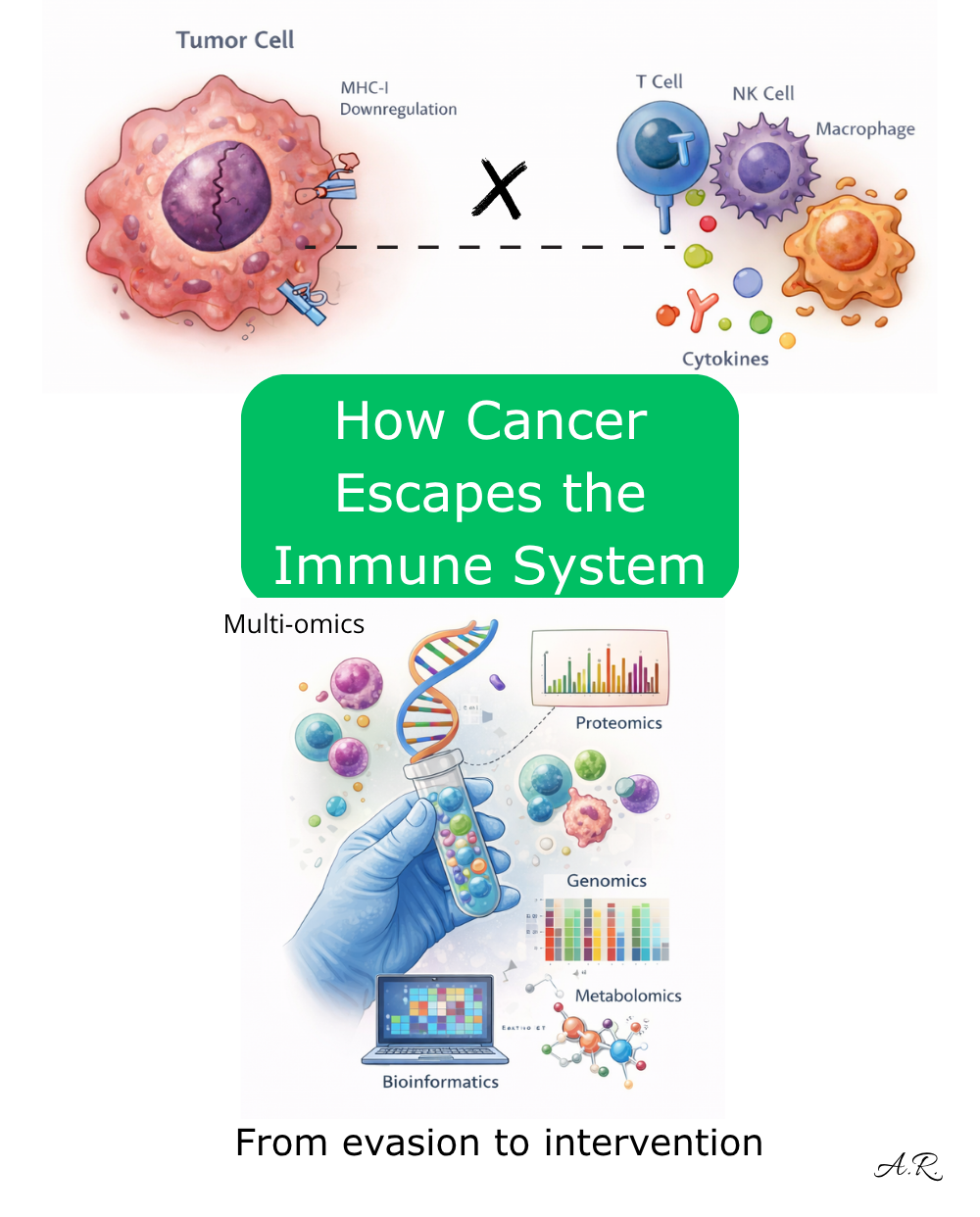
How Cancer Escapes the Immune System—and What We’re Learning to Fight Back
The Hidden Battle Shaping Disease Progression
Introduction: A powerful system…but
Deep within our body, a powerful system is constantly at work—detecting danger, eliminating threats, and maintaining balance. This is the immune system: a sophisticated, adaptive network that quietly destroys abnormal cells every day, including those that could become cancer. In fact, most of us likely develop abnormal cells throughout our lives—but never know it—because the immune system quietly removes them.
So why does cancer still emerge?
The answer is not that the immune system is weak. It’s that cancer is adaptable and constantly evolving. It is a dynamic process that can learn how to survive within the very environment designed to destroy it. Over time, it doesn’t simply resist the immune system—it begins to outmaneuver it.
What unfolds is a silent, continuous battle inside the body—one that we are only beginning to fully understand.
A Dynamic Battle, Not a One-Time Event
When cancer first appears, the immune system often responds effectively. Immune cells such as T cells and natural killers (NKs) recognize abnormal signals on cancer cells and eliminate them. This phase, known as immune surveillance, is a critical first line of defense.
However, cancer does not remain static. As tumor cells divide, they accumulate genetic, epigenetic, and molecular changes. Some of these changes allow them to survive immune attack. Over time, a selection process occurs: cells that are easily recognized are destroyed, while those that can evade detection persist and expand. This leads to the emergence of clonotypes that are increasingly resistant to immune attack.
This evolutionary process—often described as immunoediting—progresses through three broad stages:
- An initial phase where the immune system eliminates many cancer cells
- A period of equilibrium where some resistant cells survive under immune pressure
- A final phase where cancer escapes immune control entirely
By the time cancer becomes clinically detectable, it has often already developed sophisticated ways to avoid immune destruction.
How Cancer Learns to Evade the Immune System
One of the most fascinating and challenging aspects of cancer biology is that tumors rarely rely on a single mechanism to survive. Instead, they deploy multiple strategies simultaneously, creating layers of defense against immune attack.
One of the simplest, yet most effective, strategies is invisibility. For immune cells to recognize cancer, tumor cells must display abnormal markers—known as antigens—on their surface through molecules known as MHC class I. However, cancer can reduce or completely lose these markers, or alter how they are presented. In doing so, it essentially becomes less visible to immune surveillance, slipping under the radar.
But even when cancer is recognized, it has ways to stop the attack.
The immune system is tightly regulated to prevent excessive damage to healthy tissues. It uses molecular “brakes,” known as immune checkpoints, to control the intensity of immune responses. Cancer cells exploit this system by activating these inhibitory pathways—effectively sending a signal that tells immune cells to stand down. Instead of being destroyed, the tumor is tolerated. While PD-1 and CTLA-4 are the most well-known checkpoints, recent research has revealed a broader network of inhibitory signals, including LAG-3, TIM-3, and TIGIT, which further contribute to immune suppression. This redundancy makes it increasingly difficult for the immune system to mount an effective response.
At the same time, immune cells themselves can become progressively less effective. T cells, which are central to anti-tumor immunity, may enter a state known as exhaustion. In this state, they remain present in the tumor but lose their ability to function properly—they no longer proliferate efficiently, produce key signaling molecules, or kill cancer cells effectively. It is as if the immune system’s strongest soldiers are still on the battlefield, but too fatigued to fight.
Cancer also reshapes its surroundings—the tumor microenvironment—to its advantage. It recruits and reprograms other cells to suppress immune responses, creating a local environment that actively inhibits immune activity. Instead of being hostile to the tumor, this environment becomes protective.
In parallel, tumors compete with immune cells for essential resources such as oxygen and nutrients. This metabolic competition further weakens immune function, making it even harder for the body to mount an effective response.
Taken together, these strategies form a highly coordinated system of immune evasion. Cancer is not simply avoiding detection—it is actively engineering conditions that favor its survival.
Immunotherapy: A Breakthrough That Changed the Field
Our growing understanding of these mechanisms has led to one of the most important advances in modern medicine: immunotherapy.
Instead of targeting the tumor directly, immunotherapy aims to restore or enhance the immune system’s ability to fight cancer. One of the most successful approaches has been the development of drugs that block immune checkpoints, including PD-1 and CTL-4. By inhibiting these “brakes,” these therapies allow T cells to regain their activity and attack cancer cells more effectively.
In some cancers, the results have been extraordinary. Patients with advanced disease—once considered untreatable—have experienced long-term remission.
But this success comes with an important limitation.
Not all patients respond.
In fact, a significant proportion of tumors remain resistant to immunotherapy. This is not because the therapy is ineffective, but because cancer’s evasion strategies are complex and varied. If immune cells are absent, exhausted beyond recovery, or suppressed by the tumor environment, simply releasing the brakes may not be enough.
This has revealed a critical insight:
Activating the immune system is necessary—but not sufficient.
To be effective, therapies must address the full complexity of tumor–immune interactions.
A New Perspective: Cancer as a Co-Evolving System
One of the most important shifts in recent years is the recognition that cancer and the immune system are not acting independently. They are co-evolving.
The immune system applies pressure on the tumor, selecting for resistant cells. At the same time, tumor evolution shapes how the immune system responds. This continuous feedback loop drives both tumor progression and immune adaptation.
Understanding this interplay requires moving beyond static snapshots of tumors. It demands a dynamic view—one that captures how both systems change over time.
This is where new technologies are transforming the field. Advances in single-cell analysis and multi-omics approaches now allow researchers to study tumors and immune cells at unprecedented resolution. These tools reveal hidden layers of complexity, including:
- Diverse immune cell states within the same tumor
- Distinct evolutionary trajectories of cancer cells
- Previously unrecognized mechanisms of resistance
These insights are beginning to redefine how we think about cancer progression and treatment.
🧬 The Power of Multi-Omics: Seeing the Full Picture
If cancer and the immune system are co-evolving in a dynamic and complex way, then studying them through a single lens is simply not enough.
For years, much of cancer research focused on individual layers of biology—most notably genomics. While identifying mutations has been critical, we now know that DNA alone does not fully explain how tumors behave, how they interact with the immune system, or why they respond—or fail to respond—to treatment.
This is where multi-omics comes in.
Multi-omics refers to the integration of multiple layers of biological information, including:
- Genomics (DNA mutations and alterations)
- Transcriptomics (gene expression patterns)
- Proteomics (protein abundance and signaling activity)
- Epigenomics and metabolomics (regulatory and metabolic states)
Each layer provides a different perspective. But it is their integration that begins to reveal the true complexity of cancer.
For example, a mutation identified at the genomic level may not translate into an active protein. Conversely, critical signaling pathways—especially those involved in immune responses—are often regulated at the protein level through modifications that cannot be captured by DNA or RNA analysis alone.
When it comes to tumor–immune interactions, this becomes even more important.
The immune response is not determined by genes alone—it is shaped by:
- Dynamic protein signaling networks
- Cellular states within the tumor microenvironment
- Metabolic conditions that influence immune cell function
By integrating these layers, multi-omics allows us to move from static descriptions of tumors to a more functional understanding of how they operate and evolve.
It also helps uncover patterns that would otherwise remain hidden. For instance:
- Why some tumors appear “inflamed” and responsive to immunotherapy
- Why others remain “cold” and resistant
- How immune suppression emerges and evolves over time
Importantly, multi-omics is not just about generating more data—it is about asking better questions.
It enables researchers to connect molecular changes to biological mechanisms, and ultimately, to clinical outcomes.
In the context of cancer and immune evasion, this integrated approach may be one of the most powerful tools we have to understand—not just what cancer is—but how it adapts, interacts, and survives.
Toward Smarter, More Effective Therapies
The future of cancer therapy lies in embracing this complexity rather than simplifying it.
Instead of relying on single treatments, researchers are increasingly exploring combination strategies that target multiple aspects of tumor–immune interaction. These may include:
- Enhancing immune activation
- Reversing T cell exhaustion
- Reprogramming the tumor microenvironment
- Targeting tumor-specific vulnerabilities
At the same time, there is a growing emphasis on personalization. Every tumor is different, and so is every immune response. By integrating genomic, transcriptomic, and proteomic data, it may become possible to design therapies tailored to each patient’s unique tumor–immune landscape.
This is where a systems-level understanding—bridging multiple layers of biology—becomes essential.
Final Insight: Learning to Stay One Step Ahead
Cancer is often described as a disease of uncontrolled growth. But this description is incomplete.
At its core, cancer is a disease of adaptation.
It evolves, responds to pressure, and finds ways to survive in an ever-changing environment. The immune system, despite its power, is part of that environment—and therefore part of the evolutionary game.
The challenge—and the opportunity—lies in understanding this game well enough to anticipate cancer’s next move.
Because ultimately, defeating cancer may not depend on attacking it harder.
It may depend on thinking ahead of it.
Author

Ayman Reffai
Dr. Ayman Reffai is a dedicated PhD, Fulbright alumnus, and ReachSci committee member. He got his PhD with the highest honor in Molecular Biology, Medical Biology, Bioinformatics, and Biotechnology with affiliations at the School of Medicine, Stanford University (US), and FSTT, Abdelmalek Essaadi University (Morocco) as part of the Fulbright program. Dr. Ayman Reffai is driven by a passion for scientific research and its potential to improve lives. With a strong commitment to making a positive impact on both the scientific community and society at large and a desire to inspire and guide others, Ayman actively engages in research, teaching, mentoring, and fitness endeavors.

Leave a Reply